Stained Glass Windows – Pictures of Faith
By Stained Glass Artists Association
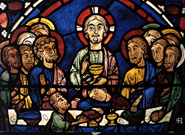
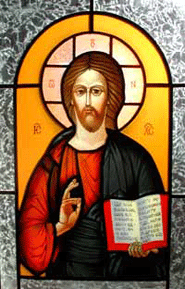
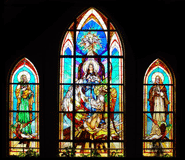
The origins of the first stained glass windows are lost in history. The technique probably came from jewelry making, and mosaics. Stained glass windows as we know them seemed to arise when substantial church building began. By the 10th century, depictions of Christ and biblical scenes were found in French and German churches and decorative designs found in England. Since nearly all church goers were illiterate, it was the windows that showed these Christians their faith.
Glass is a jewel like substance made from the most ordinary materials: sand transformed by fire. Before recorded history, man learned to make glass and color it by adding metallic salts and oxides. These minerals within the glass capture specific portions from the spectrum of white light allowing the human eye to see various colors: gold produces stunning cranberry, cobalt makes blues, silver creates yellows and copper makes greed and brick red.
Techniques of stained glass window construction were described by the monk Theophilus who wrote a “how to” for craftsmen about 1100 AD. It describes methods little changed over 900 years. “If you want to assemble simple windows, first mark out the dimensions of their length and breadth on a wooden board, the draw scroll work or anything else that pleases you, and select colors that are to be put in Cut the glass and fit the pieces together with the grozing iron. Enclose them with lead cames (binding material) and solder on both sides. Surround it with a wooden frame strengthened with nails set it up in the place where you wish.”
The Gothic age produced the great cathedrals of Europe and brought a full flowering of stained glass windows. Churches became taller and lighter, walls thinned and stained glass was used to fill the increasingly larger openings in them. Stained glass became the sun filled world outside. Abbot Suger of the Abbey of St. Denis rebuilt his church in what is one of the first examples of the Gothic style. He brought in craftsmen to make the glass and kept a journal of what was done. He truly believed that the presence of beautiful objects would lift men’s’ souls closer to God.
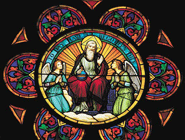
Stained glass windows are often viewed as translucent pictures. Gothic stained glass windows are a complex mosaic of bits of colored glass joined with lead into an intricate pattern illustrating biblical stories and saints lives. Viewed from the ground, they appear not as picture but as a network of black lines and colored light. Medieval man experienced a window more than he read it. It made the church that special, sacred dwelling place of an all powerful God.
Most people during the middle ages did not read and only learned the stories from the Bible from sermons or through the pictures present in the stained glass windows found in the church.
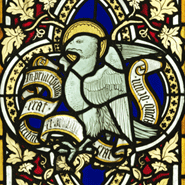
We see medieval craftsmen were more interested in illustrating an idea than creating natural or realistic images. Rich, jewel colors played off milky, dull neutrals; Paint work was often crude and unsophisticated: dark brown enamel, called grisalle, was matted to the glass surface to delineate features not to control the transmission of light.
In the 15th century, the apex of high Gothic, the way stained glass was viewed changed. It became more a picture and less an atmosphere. Paler colors admitted more light and figures were larger, often filling the entire window. Paint work became more sophisticated, more like easel painting. The rediscovery of silver stain allowed the artist to realistically depict yellow hair and golden garments.
Stained glass artist became glass painters as the form became closer and closer to panel painting. Lead line that were once accepted as a necessary and decorative element became structural evils to be camouflaged by the design. The renaissance brought the art of the stained glass into a 300 – year period where windows were white glass heavily painted. They lost all their previous glory and it seemed the original symbolism and innate beauty of stained glass was forgotten.
In this period, stained glass became a fashionable addition to residences, public buildings and churches. Heraldic glass showing detailed shields and coats of arms on simple, transparent backgrounds was common. Much of what stained glass was became, has long since been forgotten. The 18th century saw the removal of many medieval stained glass windows. They were destroyed as hopelessly old fashioned and replaced by painted glass. England in the mid 1800’s saw a revival of interest in Gothic architecture. Several amateur art historians and scientist rediscovered the medieval glass techniques. Pieces of glass were tested and their color secrets unlocked.
Glass studios in England made their versions of medieval windows for Gothic Revival buildings. The Bolton Brothers, English immigrants, established one of the first stained glass studios in America. These Gothic style windows enhanced churches and simple ornamental windows and painted figural windows were the norm until the development of a distinctive American style.
John La Farge and Louis Comfort Tiffany were two American artists who began experimenting with glass. Contemporaries, but working independently, they were trying to develop glass that possessed a wide range of visual effects without painting. They soon became competitors. La Farge developed and copyrighted opalescent glass in 1879. Tiffany popularized it and his name became synonymous with opalescent glass and the American glass movement. La Farge and Tiffany used intricate cuts and richly colored glasses within detailed, flowing designs. Plating or layering glass layers achieved depth and texture. Both Lafarge and Tiffany made windows for the private homes of the elite as well as churches.
The process of using thin strips of copper as a substitute for lead came allowed for intricate sections within windows. Tiffany adapted the technique to construct lampshades and capitalized on the new innovation of electric lighting. Tiffany’s customers were wealthy, turn of the century families including the Vanderbilts and Astors. The Tiffany style prompted many imitators and opalescent windows and shades remained popular through the turns of the century.
Taste changed after World War II. A revival of archeological accuracy in architecture called for new gothic glass windows for the NeoGothic churches. La Farge died in 1910 and interest in opalescent glass waned and Tiffany remained its last defendant until his death in 1933 and the subsequent bankruptcy of his studios. New craftsmen such as William Willet, Rambusch, Charles Connick and Nicolai D’Ascenzo, made windows for churches and synagogues across America.
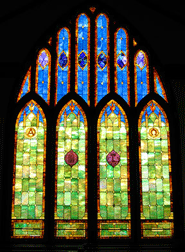
Except for church windows, stained glass remained in decline until the post World War II era. The abstract and expressionist movement in painting influenced a new group of artists to explore artistic expression in the medium of glass. Contemporary church windows may in some way be closer to those of the early Gothic period. Not easy to identify scenes, they again create a pure atmosphere of light and color, inspiring a contemplative attitude through the ordinary into the mystical.
Stained glass or more appropriately, art glass is what is typically used in modern Houses of Worship or PraiseBuidings. Most PraiseBuidings will use one of four styles of decorative windows: stained glass, cathedral glass, opalescent glass and facet glass. If the budget will allow some form of decorative window should be incorporated into the PraiseBuidings. Decorative windows more than any other element define a worship space.
Stained Glass
A true stained glass window is composed from pieces of colored cathedral glass that has been hand stained by a skilled artist who applies a reddish brown or black paint over the glass and then removes this paint in order to highlight a given area. This stained glass is then baked in a kiln for 30 minutes at between 1200 to 1400 degrees. Once fired, the stained is permanently embedded into the glass. These pieces of glass are then assembled to form a picture made from glass or a true stained glass window. Stained Glass windows are typically only commissioned by Catholic, Orthodox or Episcopal churches due to their great expense. Most other Christian churches install art glass windows, although most people have universally labeled all church windows as stained glass. Stained glass windows can cost from $100 to several thousand dollars per square foot depending upon the complexity of the artwork.
Opalescent Glass
Opalescent glass is a mixed glass in which one piece of glass have from two to five color combinations swirled throughout the glass. The body of the glass is typically contains a white opaqueness which does not allow one to see through it. Opalescent glass cost starts at $40 and higher per square foot with the decorative stained glass medallions costing many times more than that.
Faceted Glass
Faceted glass is a decorative style made popular in France after World War II. This style of window is made from very thick bricks or chunks of colored glass approximately one inch thick that is shaped into facets that is held together in a mortar or epoxy. These windows have gain great popularity in recent years due to the wonderful design possibilities, low cost and low maintenance. These windows start at $40 per square foot.
Cathedral Glass
Cathedral Glass is a transparent glass that usually contains only one color of double roll glass throughout the design with small pieces of colored accent class added throughout the design. Within cathedral windows, hand-stained pictorial medallions or symbols may be included. Cathedral glass windows typically cost between $40 and higher per square foot.